Hey everyone, let’s cut to the chase—if you’re running a warehouse, stockyard, or distribution hub, you’ve probably glanced at a ramp or two and wondered: can that electric stacker I use daily actually haul goods up and down it without turning into a problem? As an electric stacker supplier who’s talked to dozens of warehouse managers, forklift operators, and small business owners, this question’s way more common than you think. It’s not a random curiosity, either—ramps are everywhere: loading docks that sit 8 inches off the ground, sloped access to storage yards, even temporary ramps for moving pallets between trailers. Let’s break this down like we would over a coffee, no stuffy jargon, no generic sales fluff. Electric Stacker
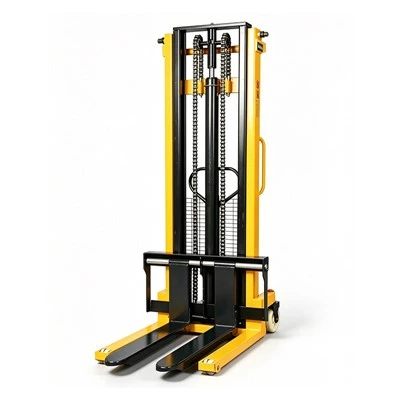
First, let’s get one thing straight: not all electric stackers are built equal, and ramps aren’t either. I’ve had customers show up with a tiny 1,500 lb capacity manual electric stacker (the kind you lift with a handle and motor) and ask if it can do a 10% ramp. Spoiler: probably not. But a 3,000 lb powered electric walkie stacker? That’s a different story. Let’s start with the basics: what makes a machine handle a slope? It’s not just how heavy the stacker itself is—it’s the motor, the traction control, the weight distribution, and the ramp’s specs.
Ramps come in different grades, and that’s make-or-break. The industry standard for warehouse ramps is “grade percentage,” which is just the rise over run. A 5% grade means for every 100 feet of horizontal length, it goes up 5 feet. A 10% grade is a steeper hill—think a driveway that’s so steep your car’s front end dips when you pull up. OSHA actually has guidelines for powered industrial trucks on ramps, right? They say any ramp steeper than 10% requires extra precautions, and most standard electric stackers are rated for up to 8% grade when loaded. Wait, but when you’re moving a full pallet, that changes the weight. A standard pallet of boxes is 2,000-2,500 lbs, so when you add the stacker’s weight (usually 2,000-3,000 lbs for walkie models), total weight’s north of 4,500 lbs. That extra weight on a steeper ramp means the motor has to work way harder, which is where a lot of cheap stackers fall short.
Here’s where the rubber meets the road: the motor. Most entry-level electric stackers (the $1,500-$2,500 ones we see a lot of small businesses buy) have a 1-1.5 kW DC motor. That’s fine for flat floors, but when you’re going up a ramp with a load, that motor’s straining. I’ve had a customer last year try to use a 1.2 kW stacker on a 9% ramp with a full pallet—he made it halfway up, the motor overheated, and he had to call a forklift to finish. On the flip side, our medium-duty electric stackers have a 2.2 kW AC traction motor, which is built for consistent torque. That’s the difference between struggling up a ramp and gliding smoothly, even with a load. AC motors also handle start-stop on ramps way better than DC ones, which is a big deal if you’re stopping midway to adjust a pallet.
Then there’s traction control. Ramps get slippery—wet wood, metal grates, even dust in a warehouse can make a ramp treacherous. Electric stackers with basic wheels (solid rubber, no tread) might slip, especially on steeper slopes. We add molded polyurethane tread wheels to all our ramp-rated stackers because they grip way better, and some even have anti-slip brake systems that engage automatically when you’re on a slope. That’s non-negotiable—no one wants their stacker rolling backward when they stop halfway up a ramp, right? I’ve heard way too many horror stories of stackers losing control because of bad brakes on ramps, so that’s a key feature to look for.
Weight distribution is another thing people sleep on. When you’re on a flat floor, a pallet on the forks balances over the stacker’s center of gravity. But on a ramp? The weight shifts forward, which can make the front wheels lose traction, or if you’re going down, shift backward, which can tip the machine. That’s why we design our stackers with a lower center of gravity—batteries are mounted low to the frame, not up top where the mast is. Also, never tilt the mast forward when going up a ramp, or backward when going down. I tell all our customers: when moving on a ramp, keep the mast vertical, and go slow. No racing up ramps, no slamming on brakes. It’s not a race.
Wait, but what about different types of electric stackers? Let’s clarify: there’s manual electric stackers (you walk behind, lift with a motor, no built-in traction for slopes), walkie electric stackers (same, but with a drive motor for moving), and rider stackers (the ones you sit on, like a tiny forklift). Rider stackers are way better for steeper ramps, obviously, because they have more power, larger wheels, and better stability. But for most small to medium warehouses, a walkie stacker that’s rated for 8-10% grade is enough—if it’s the right model.
Let’s talk about real-world examples, because numbers are great, but actual use cases matter. We sold a batch of 2.2 kW walkie stackers last quarter to a garden supply company that has a loading dock with a 7% grade and a dirt access ramp to their outdoor storage. They were using a manual forklift before, but it was too big for their narrow aisles. Now they move full pallets of soil bags and mulch up and down that ramp every day, no issues. Another customer, a manufacturing firm, had a 9% temporary ramp for a new shipping container dock—they rented a basic electric stacker first, it couldn’t handle it, then got our medium-duty model, and it’s been running 12-hour shifts on that ramp for 3 months, no motor issues.
But wait, there are limits. I always have to be honest—if your ramp is steeper than 10%, or you’re moving super heavy loads (over 3,000 lbs), an electric stacker might not be the best bet. That’s when a small electric forklift makes more sense. Also, surface condition matters. A smooth concrete ramp is way easier than a wooden ramp with gaps, or a metal ramp with rust. If your ramp has cracks or uneven spots, that can throw off the stacker’s balance, even on a gentle grade.
Now, let’s clear up some myths I hear all the time. Myth #1: Electric stackers can never go on ramps. No, that’s not true—they just need to be the right type. Myth #2: All electric stackers are the same for ramp use. Nope, entry-level vs. medium-duty vs. heavy-duty is night and day. Myth #3: You just need a powerful motor, nothing else. Brakes, wheels, center of gravity, all that stuff adds up.
So, what should you do if you’re considering using an electric stacker on ramps? First, measure your ramp’s grade. You can do this easily: measure the height it rises, divide by the length of the ramp, multiply by 100. If it’s 7% or under, any decent walkie stacker works. If it’s 8-10%, get a model with at least a 2 kW AC motor, anti-slip brakes, and treaded wheels. If it’s over 10%, look at rider electric stackers or small forklifts. Also, always check the stacker’s load capacity rating—most ramp ratings are for when you’re carrying the rated load, not empty. An empty stacker might handle a steeper ramp, but with a load, it’s different.
As a supplier, I’m not here to sell you a $5,000 stacker if a $2,500 one will do. I’ve turned down customers before who wanted to buy a basic model for a too-steep ramp, because I’d rather be honest than have them have a bad experience. But when it comes to ramps, the right electric stacker can save you time, money, and space—way more than a forklift for small warehouses. No need to navigate a big machine through narrow aisles when a compact electric stacker does the job.
Wait, one more thing: maintenance. If you’re using your stacker on ramps, you’ll want to check things a bit more often. Tread on the wheels, brake pads, and motor heat sinks—ramps mean more stress on those parts, so a quick monthly check goes a long way. We send all our customers a free maintenance checklist specifically for ramp use, which a lot of them say has saved them from breakdowns.
At the end of the day, the answer to “can electric stackers be used to move goods on ramps?” is: yes, but it depends on the stacker’s specs and the ramp’s condition. It’s not a one-size-fits-all answer, but with the right machine and a little common sense, it works perfectly for most warehouse and small business needs.
If you’re still not sure which stacker would work for your ramps, or you want to talk through your specific setup, hit us up to connect for a procurement chat. We’ll walk through your ramp specs, load sizes, and budget to point you to the right model, no pressure, no sales pitches.
Reach Forklift References
- OSHA Standard 1910.178, Powered Industrial Trucks, 2023
- Material Handling Industry (MHI) Electric Stacker Application Guidelines, 2022
- National Institute for Occupational Safety and Health (NIOSH) Ramp Safety for Powered Industrial Trucks, 2021
Huazheng Heavy Industry Machinery Equipment Co., Ltd.
With abundant experience, we are one of the most professional electric stacker manufacturers and suppliers in China. Please feel free to buy high quality electric stacker for sale here from our factory. We also accept customized orders.
Address: Room 423-101, Building C-4, Electronics Valley Technology Center, No.3088 Lekai North Street, Gaokai District, Baoding City, Hebei Province, China
E-mail: sales02@hzheavy.com
WebSite: https://www.hzheavy.com/
