Alright, let’s break down EN high strength steel plate standards like we actually care about them—from a supplier’s boots-on-the-ground perspective, no stuffy textbook fluff. I’m gonna keep this real, use the acronyms guys in the steel game actually throw around, and make sure you get exactly what matters when you’re sourcing this stuff, not just vague jargon. EN High Strength Steel Plate
If you’ve ever priced out heavy machinery, bridge components, or off-shore rig parts, you know regular mild steel just won’t cut it when weight, pressure, or abuse is on the line. As a supplier who’s haggled with fabricators, engineers, and construction leads every single week for the last 8 years, I can tell you the #1 mistake new buyers make is skipping the EN standards and grabbing whatever “high strength” plate a vendor ships. That’s a quick ticket to material failure, and nobody wants to be the guy whose crane arm cracks mid-lift (speaking from a late-night panic call with a client who cut corners once—yikes).
First off, let’s clarify what “EN High Strength Steel Plate” even means here. EN is the European Norms, right? It’s the harmonized set of standards for all EU steel (and a ton of non-EU countries that adopt ’em now, like Norway, Switzerland, even a lot of construction in the US for projects built to Euro specs). We’re not talking random “high strength” garbage from some mill that cranks out steel without a spec. This is specifically steel plate (so thicker than sheet—usually 3mm up to 200mm+ that’s actually used for structural parts) that meets EN criteria for minimum yield strength, tensile strength, and toughness. The big numbers you’ll hear tossed around are S355, S460, S690, S960—those are the workhorses, and they’re all tied to EN standards, not marketing buzzwords.
Let’s start with the basics that actually matter for you as a buyer, not just stuff in a PDF. First: the core EN standard for structural steel is EN 10025, and that’s where all those S-series grades live. Wait, but hold on—there are different parts of EN 10025 for different strength levels and applications. Like, if you need standard high strength for general structural work, that’s EN 10025-2, which covers S235, S275, S355. That’s the plate we ship for warehouse frames, small bridges, tractor cabs—stuff that needs more oomph than mild steel (S235) but isn’t for extreme conditions. Then, if you need beefier, that’s EN 10025-3, -4, -5? No, wait—wait, EN 10025-4 is for thermomechanically rolled (TM) grades, which is where the really high strength comes in: S460, S690, S960. Oh right, and if you need wear-resistant high strength (like for excavator buckets or bulldozer blades), that’s a different one: EN 10025-6, which is for quenched and tempered (QT) high strength plate. I get it, the numbering is confusing, but here’s the cheat code I give my clients: tell us what your project does, and we’ll match the right part, no guesswork.
Now, the actual standards we hold each plate to—this is the non-negotiable stuff, the part that separates a reputable supplier from a fly-by-night guy. Let’s talk about the mechanical properties first, because that’s why you’re buying high strength, not pretty paint. Every EN grade has a minimum yield strength (that’s the point it stops bending and stays deformed, right? Not good for structure) and a tensile strength (how much force it can take before snapping). For example, S355 plate (super common) has a min yield of 355 MPa for thickness up to 16mm, and stays at ~345 MPa for thicker stuff, because thicker plate is harder to get that full strength. If I sell you S355 that only hits 330 MPa, that’s not EN compliant, full stop. I once had a vendor try to pass off sub-standard plate as S355, and our QC team caught it before it shipped—saved a client from a huge issue. That’s why we have our own in-house testing, plus we get mill test reports (MTRs) straight from the mill, which is non-negotiable per EN rules.
Then there’s toughness, which is the thing people sleep on. Especially if you’re working in cold climates—freezing temps make steel brittle, and a crack that starts at a weld can spiral fast. EN standards specify impact testing at certain temperatures, usually Charpy V-notch testing, right? For example, S355JR is tested at room temp (20°C), S355J2 is tested at -20°C, S350NL is at -50°C, perfect for projects in places like Scandinavia or Canada. If you’re building a wind turbine tower in northern Germany, and you order JR grade thinking it’s high strength, that’s gonna shatter in winter. I can’t stress this enough—toughness spec is not a “nice to have,” it’s in the EN standards, and you have to match it to your operating environment.
Wait, there’s also the physical specs, like dimensional tolerances. EN has strict rules for how flat, how straight, how uniform the thickness of the plate is. If your plate is 50mm thick but some spots are 45mm, that’s an issue when you’re machining it for a weld, or fitting it to a crane arm. EN 10029 covers plate tolerances, and we never ship plate that’s outside those limits. We’ve turned down a whole shipment once because a batch was off by 2mm in thickness—even though it was “close enough” by some vendor’s loose rules. Our clients trust us because we don’t cut those corners.
Then there are the application-specific EN standards, because sometimes you need high strength steel for stuff that’s not just generic structure. Like, if you’re building off-shore oil rigs, that’s EN 10225, which is specifically for weldable fine grain steel for offshore structures, with way stricter toughness and corrosion resistance. If you’re making pressure vessels or boilers, that’s EN 10028, separate from the structural steel stuff. And for pipelines? EN 10208 is the one. We work with a lot of energy and infrastructure clients, so we stock these application-specific grades too, because they follow their own EN rules, not just the general 10025 stuff.
Now, a common question I get: what’s the difference between EN grades and, say, ASTM grades if you’re working with North American clients? A lot of our clients are in EU, but also US projects built to Euro specs, so we get this all the time. For example, S355 is kinda like A572 Grade 50, but not exactly—because the EN standard has stricter impact testing for cold environments, whereas ASTM might be more flexible. That’s the stuff we explain to clients, because we don’t want them ordering the wrong grade for their spec. We don’t just say “here’s S460” we tell you what it’s good for, and what it’s not, per EN rules.
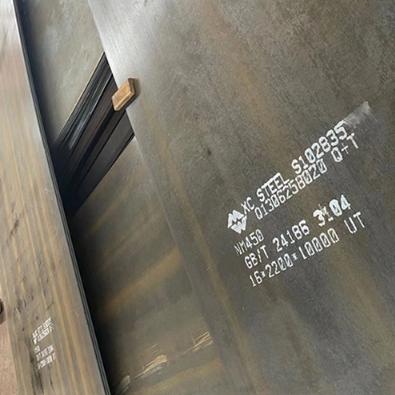
Wait, also—what about the marking on the plate? EN requires every compliant plate to have a clear, permanent marking: the grade, the mill number, the heat number (so you can trace it back if there’s an issue), the thickness, and the EN standard number. No marking, no MTR, no EN compliance. That’s a quick check anyone can do when the plate arrives. If it’s unmarked, send it back. We never ship plate without proper marking, period.
Let me also talk about why this matters for you, as someone sourcing this stuff. I’ve had clients come to me after a bad experience where their last vendor didn’t follow EN standards, so their project got delayed, or failed inspection. Inspectors (like TÜV or Bureau Veritas) will check the EN compliance before they sign off on a big project—no MTR, no proper testing, that project stops. As a supplier, we don’t cut corners here because we’ve built our business on repeat clients, not one-off cheap sales. We test every batch, we get the MTRs, we make sure every plate meets the exact EN standard you specified, nothing less.
Now, before I wrap this up, let’s go over the quick checklist I give every new client when they’re ordering EN high strength steel plate: 1) Pick the right EN grade (not just “high strength”—match S355 vs S460, toughness temp, application spec), 2) Make sure the plate has a mill test report that matches the EN standard, 3) Check the markings for grade, heat number, and standard, 4) Confirm dimensional tolerances meet EN 10029. Skip any of these, and you’re taking a risk.
If you’re working on a project right now—whether it’s a new bridge, farm machinery, wind turbine, or warehouse expansion—and you’re not 100% sure which EN high strength steel plate you need, hit us up. We don’t do pushy sales pitches, we just send our QC sheet, MTR samples, and walk you through exactly what grade will work best, no hidden fees, no last-minute surprises. We’ve been doing this long enough that we know how stressful sourcing steel for a big project can be, so we make it easy.

Just reach out, tell us your project, and we’ll hook you up with the right plate, 100% EN compliant, no junk.
EN High Strength Steel Plate References:
EN 10025: Hot rolled products of structural steels
EN 10029: Tolerances on dimensions and shape for hot rolled steel plates of 3 mm and above thickness
EN 10025-4: Technical delivery conditions for thermomechanical rolled weldable fine grain structural steels
EN 10025-6: Technical delivery conditions for quenched and tempered high strength structural steels
EN 10225: Weldable fine grain steels for offshore structures and pipelines
Gnee Steel (Tianjin) Co., Ltd.
As one of the most professional en high strength steel plate manufacturers and suppliers in China, we also support customized service with low price. We warmly welcome you to buy high quality en high strength steel plate in stock here from our factory. If you have any enquiry about free sample, please feel free to email us.
Address: No.4-1114, Beichen Building, Beicang Town, Beichen District, Tianjin, China
E-mail: alloy@gneesteelgroup.com
WebSite: https://www.chinavesselplates.com/
