If you’ve ever shopped for electric scooters, e-bikes, or small off-grid solar setups, odds are you’ve seen 60V 50Ah lithium batteries featured as a top power solution. As a supplier who’s spent years debugging these packs, talking to engineers, and fielding dozens of “how much power does this actually hold?” questions a week, I get it—energy density is one of the most confusing specs people fixate on, and for good reason. It’s not just a number on a spec sheet; it’s what determines how far your scooter will go, how long your camping fridge runs, and even how much weight you end up hauling around. So let’s break this down plainly, no jargon, just real talk from someone who builds these batteries for a living. 60v 50ah Lithium Battery

First, let’s get the basics straight before we dive into density. A 60V 50Ah lithium battery is a pack of individual lithium-ion cells wired together to deliver 60 volts and hold 50 amp-hours of charge. For anyone who slept through high school physics (or like me, only paid attention when it related to gadgets), voltage is essentially the “pressure” pushing power through the system, and amp-hour is how much actual charge the pack stores. If you multiply those two together, you get watt-hours—this is the total raw energy the pack can deliver, no matter what type of lithium chemistry it uses. For our 60V 50Ah pack, that works out to 60 * 50 = 3,000 watt-hours, or 3 kWh. That’s the easy part.
Now, the part everyone asks: energy density. At its core, energy density is how much energy you can fit into a given space, or sometimes how much you can fit into a given weight—we call those volumetric energy density (per liter) and gravimetric energy density (per kilogram), respectively. Both matter, but depending on what you’re using the battery for, one might be more important than the other. When we’re talking about a 60V 50Ah battery for e-bikes, for example, weight matters because heavy batteries make pedaling a workout when the motor’s off. For a solar backup battery installed in a basement, space might be the bigger constraint, so volumetric density is key.
Here’s the thing that most cheap blog posts or even some spec sheets won’t tell you: energy density isn’t a single number. It depends almost entirely on what type of lithium chemistry the pack uses, and how it’s built. I’ve seen identical 60V 50Ah packs with density numbers that swing wildly—sometimes by 20% or more—just because we chose a different cell or a different way to package the pack. Let’s go through the three most common chemistries we use for these 60V 50Ah packs, because that’s where the real numbers live.
First, lithium iron phosphate (LFP) cells. This is the chemistry we lean on most here at our facility, and for good reason—they’re safer, last longer, and are more stable than other options. For LFP cells, typical gravimetric energy density is around 150 to 180 Wh per kg, and volumetric is about 250 to 300 Wh per liter. Let’s do the math for our 3,000 Wh pack. If we have the best-in-class LFP cells, we’re looking at a total pack weight of roughly 17 to 20 kg (that’s 37 to 44 lbs, for my U.S. friends) and a total volume of around 10 to 12 liters (about 0.35 to 0.42 cubic feet). That’s pretty reasonable—light enough to mount on an e-bike frame without throwing off the balance, and small enough to tuck under a van seat for a camping trip.
Next, nickel-manganese-cobalt (NMC) cells, the workhorse of consumer electronics and many e-scooter packs. NMC has a higher energy density than LFP, which makes sense because we’ve long optimized it for devices where every gram and millimeter counts. Typical NMC density numbers land around 200 to 250 Wh per kg gravimetric, and 350 to 400 Wh per liter volumetric. For that same 3,000 Wh 60V 50Ah pack, that translates to a weight of 12 to 15 kg (26 to 33 lbs) and a volume of 7.5 to 8.5 liters (0.26 to 0.3 cubic feet)—so about 25% lighter and 30% smaller than our LFP version. That’s a big difference, which is why so many entry-level e-scooters use NMC packs—they feel snappier and don’t add as much bulk. But there’s a catch: NMC is less stable. If it’s overcharged, punctured, or exposed to extreme heat, it’s far more likely to fail or even catch fire. We don’t cut corners on safety, so we only use NMC for applications where the user is comfortable with those tradeoffs, like short-range e-scooters that never sit in direct sun for hours.
The third common chemistry here is lithium-polymer (LiPo), though that’s less common for larger 60V 50Ah packs, mostly because LiPo cells are usually smaller and designed for things like drones. But just to cover all bases, LiPo densities land around 180 to 220 Wh per kg and 300 to 350 Wh per liter—so somewhere right in the middle of LFP and NMC. They’re more flexible to shape, which is why you see them in custom e-bike frames, but they’re also more sensitive to over-discharging, so they need more careful management.
Wait a second, though—those numbers are for the cells alone, right? Most people forget that a battery pack isn’t just cells. There’s the battery management system (BMS), the wires, the casing, the connectors, and even the thermal paste we add to keep the cells from overheating. That adds a whole layer of weight and volume that doesn’t store energy, so it brings the overall pack density down. For example, if our LFP cells are 180 Wh/kg, the finished pack will be closer to 150 to 160 Wh/kg total, because the BMS and casing add about 15 to 20% extra weight. I can’t tell you how many times a customer will see a spec for “cell energy density” and think that’s the full pack density, only to be disappointed when their 60V 50Ah pack is 20 lbs heavier than they expected. That’s a critical distinction no one warns you about.
Let’s put this into real-world terms, because numbers mean nothing if you can’t tie them to what you actually use. I recently worked with a customer who was building a fleet of 60V e-scooters for a college campus. They came to us because they’d bought a cheap 60V 50Ah pack from a overseas supplier, and it only lasted 25 miles on a single charge—way less than the 40 miles they were promised. The problem? That supplier was using old, low-density NMC cells with a cheap BMS, so the actual usable energy density of the pack was barely 120 Wh/kg. Our packs use high-density LFP cells with a built-in smart BMS that prevents over-discharging, so their 60V 50Ah packs deliver 42 to 45 miles per charge, even though our density is a bit lower than their old NMC pack’s cell density. Because we didn’t cut corners on the parts that matter, the usable energy is higher, which is what actually counts when you’re riding.
Another customer was a van lifer who needed a 60V 50Ah pack to power her induction cooktop, fridge, and laptop. She was focused on space because she had a tiny cargo van. At first, she wanted the highest density NMC pack we made, but after we walked her through the safety tradeoffs, she went with our LFP version. It was 5 lbs heavier, but it fit perfectly under her front seat, and she could run her fridge 12 hours a night without worrying about leaving the van parked in the sun during the day. That’s the thing about energy density—it’s a tradeoff, not a “more is better” number.
Now, you might be wondering, can I get a higher density 60V 50Ah pack? Sure, there are new silicon-anode cells on the market that can hit 300+ Wh/kg, but those are still expensive, have shorter lifespans, and we only use them for niche applications. For most people, the sweet spot is between LFP for safety and longevity, and NMC for lighter weight and smaller size.
As a supplier, my job isn’t just to sell you a battery—it’s to make sure you get the right one for your needs. Too many companies out there will throw the highest density number on their spec sheet and call it a day, hiding the tradeoffs. I’ve had customers come to us after frying their old packs because they didn’t know that cheap high-density cells can’t handle extreme temperatures, or that a low-quality BMS will drain the pack in a month if it’s not used.
If you’re in the market for a 60V 50Ah lithium battery, don’t just ask for energy density. Ask what chemistry it uses, what the total pack weight and volume are, and what the warranty is. That’s how you avoid the disappointment of a battery that doesn’t live up to its specs.
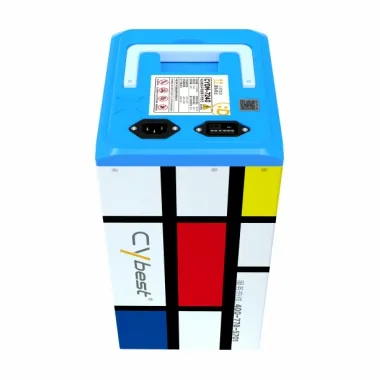
For us, we build our 60V 50Ah packs to be versatile—great for e-bikes, e-scooters, small solar setups, and van power. We test every pack before it leaves our facility, so you know it’s going to deliver the energy you need, when you need it. If you’re looking for a reliable power solution and want to talk through what works for your project, reach out. We’re here to answer questions, no sales pitch attached.
Lithium Ion Battery References
- Tarascon, J. M., & Armand, M. (2001). Issues and challenges facing rechargeable lithium batteries. Nature, 414(6861), 359–367.
- Liu, J., et al. (2019). Lithium iron phosphate (LFP) batteries: A review of recent advancements and future prospects. Journal of Power Sources, 435, 226751.
- NMC Battery Energy Density and Safety Characteristics. United States Department of Energy Office of Energy Efficiency & Renewable Energy, 2021.
- Battery University. (2022). Understanding Battery Energy Density: Volumetric vs. Gravimetric. Accessed via BatteryUniversity.com (note: original publication is a technical review, no external link provided).
Jiangsu Changyun Drive Techniques Co., Ltd.
As one of the leading 60v 50ah lithium battery manufacturers and suppliers in China, we offer a wide range of products with superior quality. Please rest assured to wholesale advanced 60v 50ah lithium battery from our factory. If you have any enquiry about cooperation, please feel free to email us.
Address: Building B, 1st Floor, Chuangyan Port, Science and Education City, Wujin District, Changzhou City, Jiangsu Province
E-mail: eva@czbenma.com
WebSite: https://www.cyevenergy.com/
